
On February 4, air pollution was officially recognized as a cancer risk factor in Europe, following its inclusion in the 5th edition of the European Code Against Cancer (ECAC5). This is not just another “health recommendation.” It marks a clear shift in perspective: air is no longer a matter of comfort or urban aesthetics — it is a matter of prevention and public health.
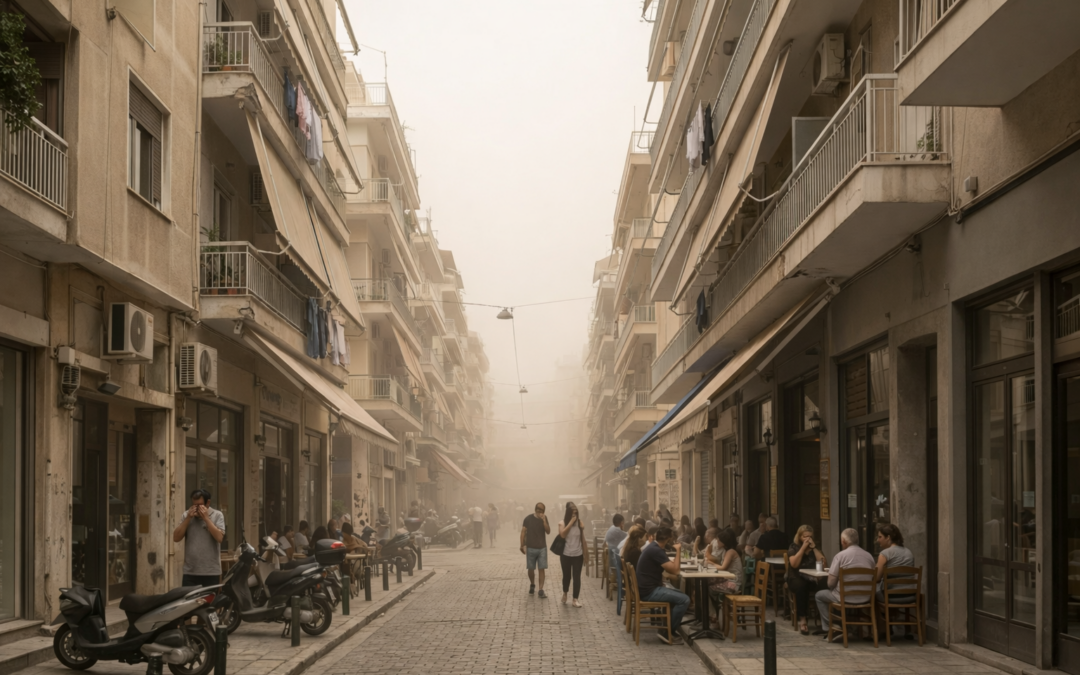
In recent days, Greece and Cyprus have been suffocating under heavy dust. This is not an isolated incident. Year after year, the same pattern returns — a recurring and persistent risk. The most critical point is this: air quality is passive. You don’t “choose” it the way you choose what to eat or whether to exercise. You breathe it wherever you are. And because it is passive, it is also deeply unequal. Some people live near green spaces and low-traffic areas; others live beside busy roads, construction sites, concrete, and dust. So when Europe says “air matters,” what it is really saying is that the environment we build around us is part of prevention.
But this is not only a warning. It is also an opportunity. Cities that invest in more green spaces, fewer cars, and less concrete can become more attractive to residents, workers, businesses, and visitors alike. Just as we once talked about the “cost of living,” the “cost of air” is beginning to enter the conversation. And those who turn air quality into a competitive advantage — rather than a vague environmental slogan — will be the ones who lead.
Green is not decoration. It is health infrastructure. Reducing traffic is not a “war on cars.” It is an investment in a city that can breathe. And limiting excessive concrete is not a step backward. It is a choice for better thermal comfort, less dust, a reduced urban heat island effect, and ultimately a better quality of everyday life.
If we see it as motivation, then “clean air” becomes a new reason to stay, to relocate, to work, to raise children, to start a business. The cities of the future will not compete only on salaries, rents, and infrastructure. They will compete on well-being. And well-being begins with something invisible, yet something that affects you every minute of the day: the air.
So, the real challenge is not to fear dusty days. It is to decide what kind of cities we want to be: cities that simply endure the phenomenon, or cities designed to reduce it, protect the most vulnerable, and make health the easier choice. Because when air quality is passive, the solution cannot be purely individual. It must also be collective — embedded in urban planning, mobility, green space, and in the choices we make about what and where we build.
Constantinos Loizou
CEO, EMBIO Diagnostics


